
How to Choose Your Regulator: A Buyer's Guide for Indian Divers

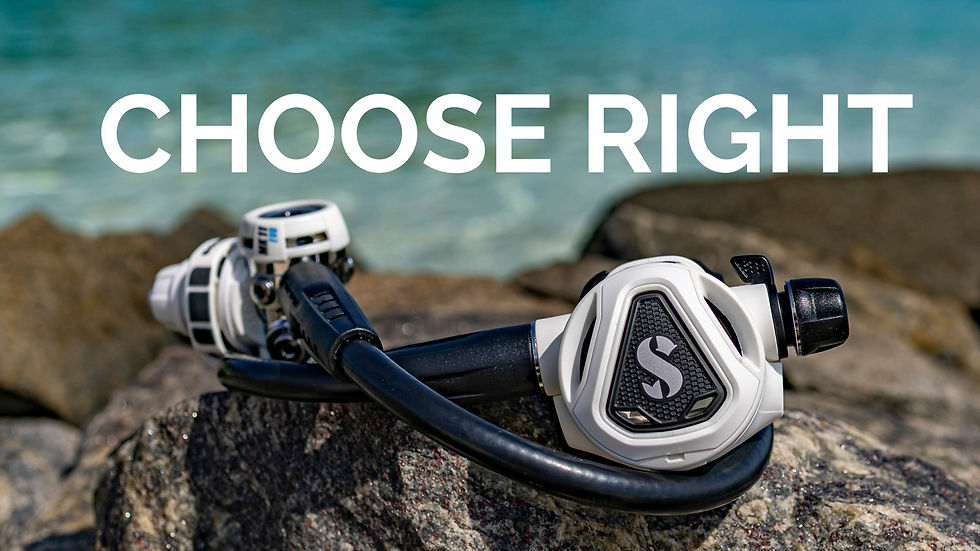
Your regulator does one job, but it is the only job that matters underwater. It turns high-pressure air into every breath you take at depth. Masks fog, fins scuff, wetsuits fade, and you keep diving. A regulator that fails does not give you a second chance.
If you have read our earlier guide on what scuba gear to buy first, you already know we rank the regulator right after the mask and fins on the ownership ladder. This guide goes deeper into how to actually pick one, and why buying it through SCUBAPRO's authorised Indian dealer matters as much as the model you choose.
Start with balanced vs unbalanced

Every regulator first stage works on one of two designs: balanced or unbalanced. We covered the mechanics of this in Part 2 of our equipment guide, but here is what it means for your buying decision.
Unbalanced first stages cost less and work fine for shallow, controlled dives. Dive schools use them for exactly this reason: they hold up to heavy rotation and keep training costs down. But breathing effort on an unbalanced system rises as your tank pressure drops and as you go deeper. You feel it most on the last third of your air supply, at the exact point in a dive when you want your gear working with you, not against you.
Balanced first stages deliver consistent airflow regardless of tank pressure or depth. For India, where a lot of our best diving means depth (wrecks off the Tamil Nadu coast, drift sites in the Andamans, deeper reef walls in Lakshadweep), a balanced regulator is not a luxury upgrade. It is the difference between a relaxed dive and a laboured one on your last five minutes of bottom time.
Interstage pressure: the number that decides everything else
Every regulator has a hidden number that matters more than any spec on the box: interstage pressure, or IP. This is the pressure your first stage hands off to your second stage before it reaches your mouth, and every manufacturer builds their regulator around a narrow target range for this number, not a single fixed value.
Here is why you should care. If IP sits too high, the second stage gets harder to hold shut, and you get free-flows, sometimes right when you jump in, sometimes at depth when you least expect it. If IP sits too low, your second stage struggles to deliver air the moment you demand more of it, which is exactly when you are finning hard or dealing with a stressful moment underwater. A regulator can look flawless, breathe fine on the surface, and still be sitting outside its safe IP range. You cannot see this from the outside. You cannot feel it during a lazy surface test. It only shows up on a gauge, during a proper service, in the hands of someone trained to read it.
This is exactly why buying from a dealer with an in-house, factory-trained service centre matters as much as the regulator itself. A well-engineered first stage gives you the range to work with. Keeping it inside that range, dive after dive, is what the right service partner actually delivers.
What a real regulator check actually looks for

Ask any dive shop what they check before handing you a rental regulator, and most will tell you they check if it breathes. That is not a real check. A properly trained technician tests for four specific conditions before a regulator ever goes back into rotation or into a customer's hands:
Lock-up. After a breath, a purge, or any disturbance to the air moving through it, does the first stage return precisely to its set interstage pressure? A properly functioning regulator resets to the same IP every time.
Drift. Does the first stage fail to fully return to that original IP after a disturbance, settling slightly off instead of resetting cleanly? This is not a leak. It is a small deviation from proper lock-up, and left unaddressed it is often the first sign that a first stage needs attention.
HP creep. Does the high-pressure seat actually hold, or does pressure slowly leak past it over time? This is a genuine leak, invisible during a dive, and it only shows up as a slowly climbing needle on a pressure gauge left connected and idle.
Low pressure droop. Does the first stage build IP and then, with no breath or demand from the diver, let it drop off on its own, only to build back up and drop again in a repeating cycle? This points to air escaping somewhere it should not, often a crack in the first stage body, and it is a structural problem, not just an adjustment issue.
None of these show up if you just breathe through a regulator on land for ten seconds, which is the extent of most "checks" a rental counter or a dive centre will do. This is also why a regulator that "breathed fine" during a demo can still fail one of these four conditions. It is also exactly why our earlier guide on when your regulator needs servicing exists: most of the warning signs divers notice in the water are the late-stage symptoms of one of these four problems going unchecked for months.
Why almost every second stage is built to fail safe

Look inside almost any modern second stage and you will find a downstream valve design. This is a deliberate engineering choice, not an accident. In a downstream valve, if a component wears out or a seal fails, the valve's natural tendency is to open and let air flow rather than seal shut and cut your air off. In an emergency, a regulator that fails by giving you too much air is a far better outcome than one that fails by giving you none.
This single design decision, made decades ago and refined ever since, is part of why modern regulators are dramatically safer than early scuba equipment. It also means a free-flowing regulator, while inconvenient and sometimes alarming underwater, is doing exactly what it was designed to do when something goes wrong: keep air moving toward you, not away.
Match the regulator to Indian conditions, not brochure specs
A regulator built and tested in Europe does not automatically perform the same way in the Bay of Bengal. Three things matter here that rarely show up in spec sheets:
Piston or diaphragm first stage. Water off the Indian coast regularly sits between 27°C and 30°C, and both piston and diaphragm first stages handle this comfortably. The real difference between the two designs is mechanical, not thermal. A piston first stage has fewer moving parts, delivers higher airflow for its size, and is naturally more tolerant of saltwater working its way into the mechanism. A diaphragm first stage has more moving parts and needs a sealed, isolated chamber specifically because the diaphragm mechanism itself is more sensitive to saltwater intrusion. That sealed chamber is exactly what environmentally sealed diaphragm regulators are built around, and it earns its keep in silty, particulate-heavy water near river mouths or monsoon runoff, or in genuinely cold water. For clear reef and wreck diving, which is most Indian diving, a well-serviced piston first stage performs just as reliably, and its simpler mechanism is easier and cheaper to service over its lifetime. Neither design is the "better" choice in general. The right one depends on where you actually dive.
Salt and humidity resistance. Coastal storage in Pondicherry, Chennai, Goa, or the islands means constant exposure to salt air even when the gear is not in the water. SCUBAPRO regulators use double chrome plating on the brass body: a layer of nickel plated first, then chrome plated over the nickel. Chrome does not bind well to brass on its own, which is why regulators plated straight onto brass tend to flake over time. Nickel bonds well to both brass and chrome, so it acts as the layer that holds everything together. That construction is what earns its price in a coastal environment like ours.
Monsoon downtime. Most Indian divers do not dive year-round. Regulators that sit unused for months during the monsoon are more prone to O-ring degradation and moisture ingress than gear used weekly. If you already own a regulator, our guide on how to know when your regulator needs servicing explains the warning signs this seasonal gap tends to produce.
Airflow and breathing resistance

Two regulators can share the same balanced design and still breathe differently. Airflow rate, the volume of air a first stage can deliver on demand, decides how the regulator performs when you are working hard: swimming against a current, finning up after a deep bottom section, or sharing air in a drill. A high-flow first stage feels barely noticeable during easy, unhurried breathing but shows its value the moment your demand spikes.
If most of your diving is calm reef diving in shallow, current-free water, this matters less. If you dive current-prone sites like the Andamans or plan on drift and wreck diving, treat airflow rate as a primary spec, not an afterthought.
Second stage: comfort you will actually notice

The second stage, the part in your mouth, gets far less attention than the first stage, but it shapes every single breath of your dive. Here is what to check when you try one:
Jaw comfort. A mouthpiece that is too large or too rigid causes jaw fatigue on longer dives. This is the same fit problem we talked about in our piece on why rental gear doesn't fit you: a regulator that was never sized for your face works against you the whole dive.
Work of breathing. This is the actual physical effort it takes to pull a breath through the second stage, measured in joules per litre. Diving's international testing standard caps this at 3.0 joules per litre for a second stage to be considered safe to use. A well-designed second stage sits far below that ceiling even at depth and under exertion, and that gap is what a low work of breathing actually feels like: a breath that takes almost no effort to draw, dive after dive, instead of one that leaves you working for air by the end of a long bottom time.
Flow rate. Just like the first stage, the second stage has its own flow rate, the volume of air it can deliver on a single strong inhale. This is what you notice most under exertion: a hard fin kick against current, a stressful moment at depth, or sharing air during a drill. Two second stages can share the same low resting work of breathing and still behave very differently the moment you actually need a large breath fast.
Venturi and dive/pre-dive switch. This control reduces free-flow risk on the surface and adjusts breathing effort underwater. Make sure it is easy to reach and switch even with gloves on.
Purge button size and placement. You will use this constantly to clear water after a regulator recovery drill or a coughing fit at depth. It should sit exactly where your thumb expects it.
Octopus, gauges, and hose configuration

Your primary second stage is only one part of the setup. Decide early whether you want a traditional octopus (backup second stage) or an integrated alternate air source like an AIR2, which combines your backup regulator with your BCD inflator. The integrated route saves a hose and simplifies your rig, which matters if you travel with your own gear for dive trips within India or abroad.
If you go with a traditional octopus instead of an integrated option, check the BCD inflator itself for a balanced power inflator design, since it will not automatically come bundled with your regulator the way it does on an AIR2. A balanced design keeps your BCD inflation rate consistent regardless of depth, where an unbalanced inflator slows down noticeably the deeper you go, right when you have less time to spare adjusting buoyancy. A good balanced inflator also lets you control the fill progressively, easing air in gradually instead of an all-or-nothing burst, which makes a real difference the first few times you are fine-tuning buoyancy near a reef.
Hose length and routing also deserve a minute of thought before you buy, especially if you already dive with a specific BCD or plan to move toward technical or wreck diving later. A regulator you can reconfigure as your diving style changes is worth more than one that locks you into a single setup.
Buy for the diving you actually do
The best regulator on paper is not always the right one for you. A recreational diver doing occasional weekend dives off Pondicherry or Goa does not need the same first stage a technical diver planning deep wreck penetration in the Andamans needs. Be honest about:
How often you dive (weekly, seasonal, a few trips a year)
How deep you typically go, and where you want to go next
Whether you dive in current, cold water, or high-particulate sites
Whether you plan to travel with your own gear or rent locally when you dive abroad
Buying above your current diving, with room to grow, is smarter than buying exactly for today's dive log. A balanced regulator with strong airflow will still serve you well if you move from occasional reef dives to deeper, more demanding sites next year. An entry-level unbalanced set will not.
Buy it in India, not overseas
A regulator bought on a trip abroad, through an overseas retailer, or from a grey-market import looks identical to one bought through an authorised Indian dealer, right up until something goes wrong. SCUBAPRO's warranty and service network is set up around authorised dealers in each country, which means a set bought outside India can leave you without valid local warranty cover, without access to genuine parts, and without a technician who is actually trained and certified on that specific model.
Confirm two things before you buy: whether you are buying from SCUBAPRO's authorised dealer in India, and whether that dealer runs an in-house, factory-trained service centre rather than outsourcing servicing to a general workshop. As we explain in our regulator servicing guide, India's saltwater, humidity, and monsoon storage cycle wear down regulators faster than the manufacturer's default service interval assumes, which makes fast, local, genuine-parts servicing far more valuable here than the small saving on an overseas price tag.
At Proscuba Marine Technology, we are SCUBAPRO's exclusive authorised distributor for India, and we service every regulator we sell through our own factory-trained centre. Buy from us on scubapro.in, and the regulator you choose today stays covered, genuine, and serviceable for every dive after, without the delays and dead ends that come with chasing warranty support across borders.
Why you rarely hear any of this before you buy
Most regulator advice online comes from two places: brochure copy rewritten by a marketing team, or a dive instructor answering from teaching experience rather than repair experience. Neither is wrong to listen to, but neither is trained to read an interstage pressure gauge or diagnose HP creep either. Instructors are certified to teach diving. Technicians are certified separately, through manufacturer-run seminars that go deep into the mechanics most divers never see, and that training is gated specifically because it involves proprietary schematics and service data manufacturers do not release publicly.
The people who actually hold this knowledge are usually busy running service benches, not writing buyer's guides, and even fewer of them sit inside the exclusive Indian distributor for the brand they service. That gap is exactly why this article exists: to hand you the parts of a technician's understanding that actually help you buy smarter, and to point you toward the one place in India where that knowledge, the genuine gear, and the after-sales service all sit under one roof.
The short version
Choose balanced over unbalanced if you dive anything beyond shallow, calm water. Prioritise airflow rate if you dive current or plan technical diving. Try the second stage in person before you commit, and buy through SCUBAPRO's authorised Indian dealer so warranty, genuine parts, and factory-trained servicing come with the purchase instead of becoming a problem later. Your mask lets you see the reef. Your fins get you there. Your regulator is what keeps you breathing the whole way through, so give it the attention it deserves, starting with where you buy it.


Comments